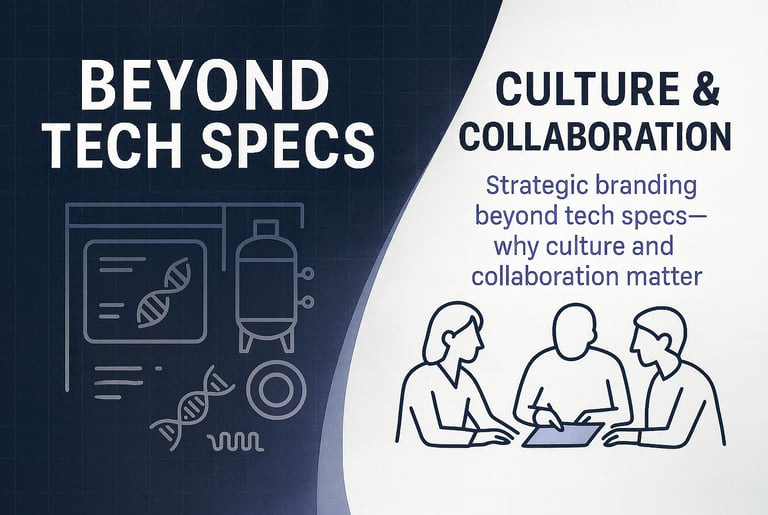
Beyond Tech Specs: Building a CDMO Brand on Culture and Collaboration

Why the strongest differentiator in advanced therapy manufacturing isn’t just your platform—it’s how you work.

Jeff Briganti

8/25/20252 min read

Tech Specs Get You on the Field—Culture Wins the Game

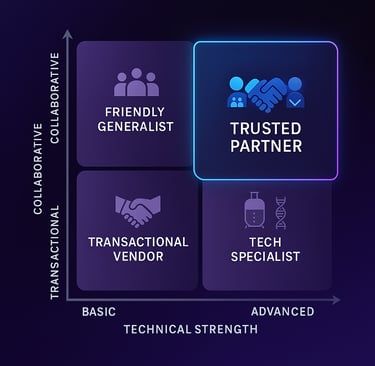
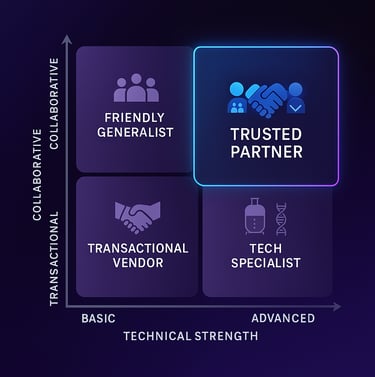
In the crowded CDMO landscape, technical capability is the ticket to entry. Every competitor can claim cGMP compliance, state-of-the-art suites, and experienced staff. But for CGT developers making a once-in-a-lifetime therapy, the decision to partner isn’t made on equipment alone—it’s made on trust, chemistry, and the assurance that you’ll work together toward regulatory and commercial success.

The truth: Capabilities get you noticed. Culture gets you chosen—and re-chosen.

Why Culture and Collaboration Are Market Differentiators

A CGT program is never “plug-and-play.” Developers need a CDMO that can flex with changing timelines, integrate with dispersed teams, and resolve issues without derailing the entire program. That level of partnership depends less on the number of isolators you have—and more on how your people think, communicate, and problem-solve.

When buyers evaluate CDMOs, they’re assessing three often-unspoken dimensions:

  • Responsiveness: How quickly do you escalate and resolve an unexpected comparability issue?

  • Transparency: Do you proactively share risks and challenges, or let them surface too late?

  • Compatibility: Can your quality, project management, and technical teams mesh with theirs at the pace they need?

Shaping a Culture-Based Brand Narrative

Many CDMOs talk about being “a partner” but never show what that looks like in practice. The leaders who succeed make their culture visible and tangible in their marketing.

Four high-impact tactics to infuse culture into your brand:
  1. Tell “how we work” stories, not just “what we have” stats.
    Replace generic capability lists with real examples of cross-functional wins—like how your PM team aligned a delayed analytics vendor without extending the critical path.

  2. Showcase cross-disciplinary expertise.
    Highlight instances where regulatory, process development, and QC teams collaborated early to prevent downstream deviations.

  3. Highlight team accessibility.
    Developers want to know they can get to your senior scientists without six layers of gatekeeping. Make this part of your value proposition.

  4. Make collaboration measurable.
    Share client satisfaction metrics, average response times, or “issue-to-resolution” cycle averages. These are just as persuasive as OEE and batch success rates.

Integrating Culture into the Commercial Process

Branding isn’t just a logo or a website—it’s how every client touchpoint reinforces your value. This requires tight alignment between marketing, BD, and operations.

Practical steps for CDMOs:

  • BD Training: Teach your BD team to sell cultural strengths with the same fluency they sell capacity.

  • Proposal Framing: Include collaboration case studies in every RFP response.

  • Onboarding Rituals: Share your communication protocols, escalation paths, and cultural “norms” with new clients—this builds trust before the first tech transfer.

The Competitive Payoff

When culture and collaboration are embedded in your marketing narrative:

  • You stand out in RFPs even when your tech specs are matched.

  • You attract clients who are more likely to be long-term, repeat partners.

  • You create resilience against capacity-driven price competition—because you’re selling a relationship, not just a slot in the cleanroom.

Final Thought:
In CGT manufacturing, the product may be science, but the experience is human. The most future-proof CDMO brands will be those that scale both their technical capabilities and their cultural capital—because the way you work together is the part competitors can’t easily copy.

Want help crafting stories that resonate?
Let’s co-author your next chapter. Contact Jeff Briganti