
Lost in the Crowd? How to Position Your CDMO in the CGT Ecosystem—Before Someone Else Does
Standing out where everyone claims to be ‘end-to-end'
Jeff Briganti
8/27/20252 min read
In the high-growth world of cell and gene therapy (CGT), the CDMO landscape is starting to feel a little like Times Square at night—crowded, noisy, and full of flashing signs that all promise the same thing.
Everyone’s “integrated.” Everyone offers “flexibility.” Everyone has “experience in CGT.”
So, how do you position your CDMO in a way that cuts through the noise and actually resonates with your ideal client?
It starts by asking a simple but critical question:
What kind of CDMO are you really?
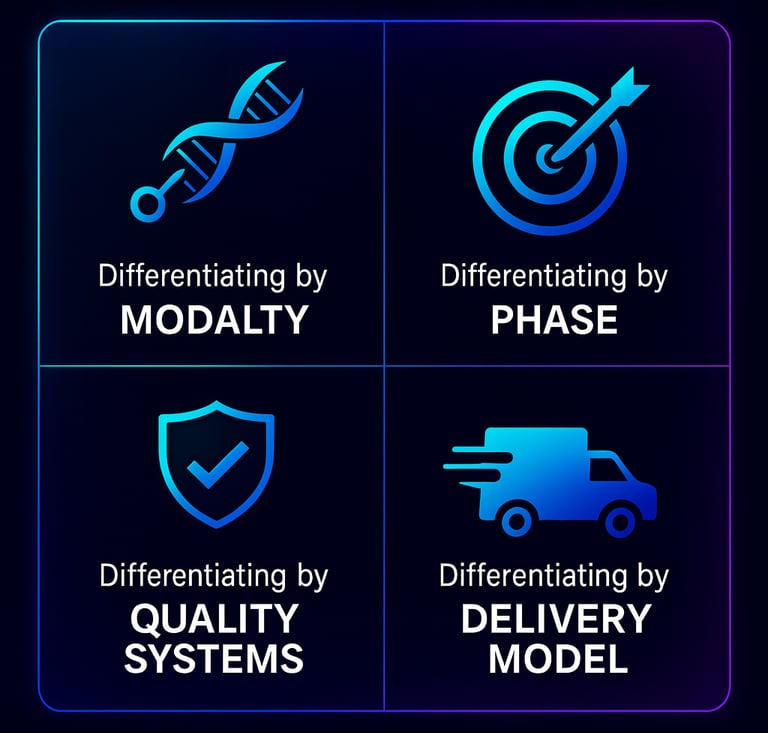
Clients don’t just want capability—they want compatibility. They’re looking for the right partner for their modality, development phase, regulatory burden, and business model. Here's a framework to help sharpen your positioning—and ensure you’re not just one of the crowd.
1. Modality Match: Are You a Specialist or a Generalist?
Are you the go-to for AAV vectors? mRNA drug product? Plasmid DNA? CRISPR-associated proteins?
If your facility, team, and track record suggest deep expertise in a specific modality, lean into that. Developers want partners who understand the nuances—from upstream process design to final release testing—without having to educate you along the way.
Example: If your facility excels in high-yield microbial fermentation for pDNA, say that. Loudly.
2. Phase Focus: Discovery to GMP—But Where Do You Shine?
“End-to-end” may sound good in a capabilities brochure, but in practice, most CDMOs excel at specific stages of the development lifecycle.
Whether you're optimized for early-phase materials or ready to support commercial-scale batches under full GMP, make that clear. Early-stage developers don’t want to overpay for capabilities they don’t need. Late-stage sponsors don’t want to tech transfer twice.
Pro tip: If you support preclinical work, highlight services like feasibility runs or QC flexibility. If you’re all-in on Phase III and beyond, talk about regulatory readiness, tech transfer protocols, and your track record with successful filings.
3. Quality Systems: What Are You Built For?
Your QMS tells a story—make sure it’s the right one.
Some developers are looking for ISO-qualified systems that move fast. Others want full cGMP compliance and expect partner audits, global regulatory alignment, and electronic batch records. Your quality culture either builds trust—or creates friction.
Takeaway: If your QMS is built for clinical-grade mRNA, say so. If you offer multiple quality tiers (RUO, High Quality, GMP), define the rules of engagement.
4. Delivery Model: Are You a Sprint Partner or a Long-Haul Ally?
Some CDMOs win by being fast, flexible, and transactional—perfect for clients who need speed and low friction. Others are built for strategic partnerships, tech stack alignment, and multi-year relationships.
Your operational structure—dedicated project managers, embedded SMEs, client portals, or even co-located teams—can be a key differentiator.
Thought starter: Position your model not just as “what we do,” but “how we deliver.” Because that’s what clients remember.
Final Thoughts: Define Yourself or Be Defined
In a space as fast-moving and capital-intensive as CGT, positioning isn’t a luxury—it’s a survival skill. If you’re not clear on where you play and how you win, your competitors will write that story for you.
Differentiation doesn’t require shouting louder. It requires speaking more clearly to the right audience.
If you’re ready to sharpen your positioning and tell a stronger CDMO story, I’d love to help.
Need help crafting your message?
Contact Jeff Briganti
Contact Us

Driving lead generation and conversion for CGT CDMOs with strategic marketing solutions.
Services
Project-Based Marketing
Part-Time Support
Fractional Leadership
Temporary Full-Time
Expertise
Lead Generation & Conversion
CGT CDMO Marketing
Digital Transformation (SEO)
Go-to-Market Strategy