
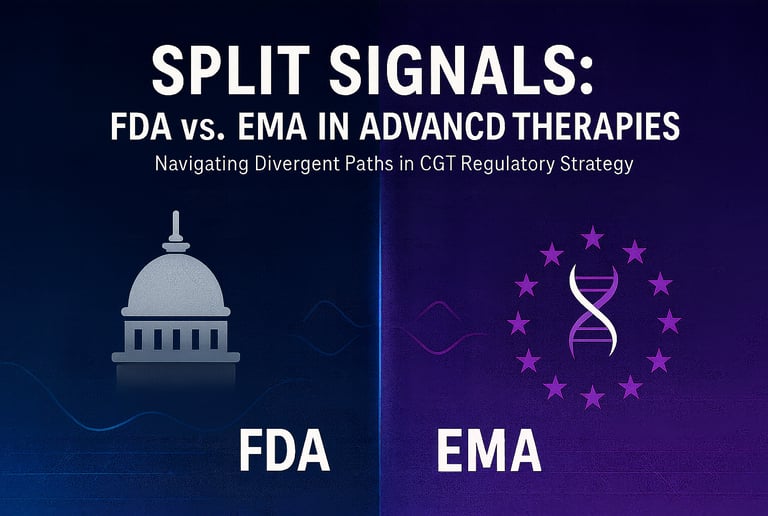
Split Signals: FDA vs. EMA in Advanced Therapies—and What It Means for Your Marketing Narrative
Jeff Briganti
9/4/20252 min read
Two Regulators, Two Realities
If you’re a CDMO supporting cell and gene therapy (CGT) developers, you already know that regulatory alignment is anything but global. The FDA and EMA may share a commitment to safety and innovation, but their frameworks for advanced therapies often diverge—in ways that ripple through your clients’ development strategies.
And if your marketing narrative doesn’t reflect that nuance? You risk sounding generic in a space that demands precision.
Why Regulatory Divergence Matters to CDMO Messaging
Marketing isn’t just about what you do—it’s about how you help your clients succeed. And success looks different depending on whether your client is preparing for a Type B meeting with the FDA or navigating EMA’s CAT review process.
Key differences that shape your story:
Terminology & classification:
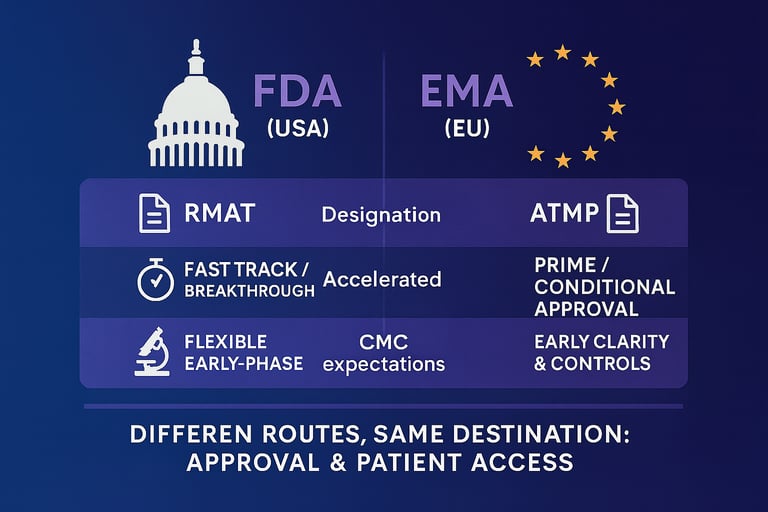
FDA uses “Regenerative Medicine Advanced Therapies (RMAT)” while EMA defines “Advanced Therapy Medicinal Products (ATMPs)”—each with distinct eligibility and incentives.
Review pathways:
FDA offers accelerated programs like Fast Track and Breakthrough Therapy. EMA leans on PRIME and conditional approval—but with different expectations around data maturity and post-market commitments.
CMC expectations:
EMA often requires earlier clarity on comparability and manufacturing controls, especially for autologous therapies. FDA may allow more flexibility in early-phase submissions.
What This Means for CDMO Marketing
Your clients aren’t just choosing a CDMO—they’re choosing a partner who understands the regulatory terrain they’re navigating. That means your marketing should reflect:
Geographic fluency:
If you support EU-bound programs, highlight your familiarity with EMA expectations, CAT interactions, and ATMP classification nuances.
CMC alignment:
Showcase how your quality systems, documentation practices, and tech transfer protocols align with region-specific regulatory demands.
Strategic foresight:
Position your team as proactive—not reactive—when it comes to regulatory shifts. Can you help clients anticipate divergence in comparability studies or release testing? Say so.
Messaging Tips for Global CDMOs
Avoid one-size-fits-all language. “GMP-compliant” means different things in different regions. Be specific.
Highlight regional wins. If you’ve supported filings or approvals in the EU or US, share those stories—context builds credibility.
Speak to regulatory strategy. Marketing isn’t just about capabilities—it’s about compatibility. Show how your expertise helps clients navigate divergent paths.
Final Thought: Precision Builds Trust
In advanced therapies, regulatory nuance isn’t a footnote—it’s a headline. CDMOs that reflect this in their marketing narrative don’t just sound smarter. They are smarter—because they’re speaking directly to the pressures and priorities their clients face.
Modality Impact Consulting helps CDMOs craft marketing strategies that resonate across borders, regulatory frameworks, and development stages. If you’re ready to sharpen your global narrative, let’s talk.
Contact: Jeff Briganti
Contact Us

Driving lead generation and conversion for CGT CDMOs with strategic marketing solutions.
Services
Project-Based Marketing
Part-Time Support
Fractional Leadership
Temporary Full-Time
Expertise
Lead Generation & Conversion
CGT CDMO Marketing
Digital Transformation (SEO)
Go-to-Market Strategy